What are the key differences between slinkies and straight pipes?
How much land do you need for a slinky or straight pipe ground array?
How deep do slinky trenches need to be?
How do slinkies and straight pipes work?
What options are available if there isn’t enough space for slinkies and straight pipes?
What are Slinkies & Straight Pipes?
Slinkies and straight pipes are the two types of horizontal ground arrays that collect heat to serve ground source heat pumps. They differ in important ways and it is worth considering which is best for your needs.
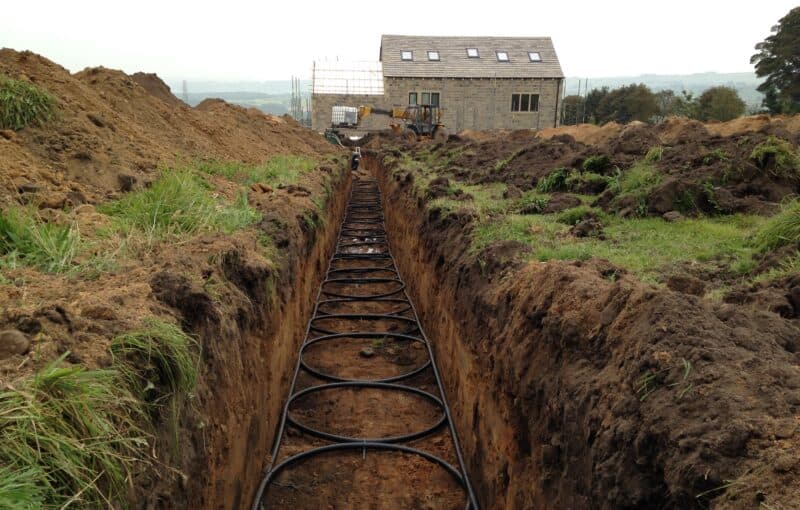
Slinkies and straight pipes are the two types of horizontal ground arrays that collect heat to serve ground source heat pumps. They differ in important ways and it is worth considering which is best for your needs.
What are the key differences between slinkies and straight pipes?
The key difference between slinkies and straight pipes is slinkies are laid in loops or coil patterns, while straight pipes are laid in straight lines. Slinkies require less digging than straight pipes, which makes them cheaper to install. Kensa supplies both.
A slinky is a length of coiled plastic pipe which is buried beneath your land or garden. The coiled pipe is usually installed horizontally and laid in long, narrow trenches about 1.2 metres deep and the same wide.
The benefits of slinkies come from their coiled patterns. Each metre of a slinky trench contains around 5 metres of pipe, so slinkies make the most of the energy in the ground. To make sure the ground retains enough thermal energy to heat your home, their trenches are spaced 5 metres apart. During installation, this spacing also gives room for excavated soil before the trenches are backfilled.
Straight pipes, on the other hand, are laid in narrower trenches with 1 metre separation. They need about five times more digging, making them more expensive and time-consuming to install, while they provide less space for excavated soil during groundworks. However, they don’t require more garden space overall, because of the larger spacing between slinky trenches.
How much land do you need for a slinky or straight pipe ground array?
The amount of land you need for slinkies or straight pipes depends on how much heat your home needs. A general rule of thumb is that for every 10 metres of slinky trench 1kW of energy can be absorbed from the ground. So, a 40-metre trench can serve a 4-kilowatt heat pump. If you need hot water too, you may need to add another slinky. As a rule of thumb, horizontal ground arrays should cover about two to three times the floor area of the building footprint they are heating. Kensa can do a heat loss survey of your home to tell you how much heat you need.
Kensa’s slinky pipes are manufactured in lengths of 30 metres, 40 metres and 50 metres. All our slinky pipes are made from high-density polyethylene which enables them to survive for 100 years. We supply them already coiled, and each slinky comes with a 25 metre tail. That means the end of the slinky trench can - if needed - be a small distance from the building. In all cases the slinkies will be connected to the heat pump via a manifold and header pipe.
How deep do slinky trenches need to be?
Slinky trenches are typically 1.2 metres wide and 1.2 metres deep, while straight pipe trenches are typically 300mm wide and 1 metre deep.
How do slinkies and straight pipes work?
Once the slinkies or straight pipes are buried in trenches, they are connected to your ground source heat pump via a manifold and header pipe. The original strata (earth) is then returned. pipes Sometimes sand is used initially to protect the pipes or slinkies from sharp stones and debris present in the earth. Once the ground has recovered, you won’t even know they are there. The pipes will give you low-cost, sustainable heating and hot water from the ground all year round and can last over 100 years.
The trenches for slinkies and straight pipes do not have to be perfectly straight, as long as the spacing between them is correct.
What options are available if there isn’t enough space for slinkies and straight pipes?
Boreholes are another option for your ground source heat pump. Because they are drilled vertically, they require less space and are very effective at drawing heat from the ground. They are more expensive to install, because they require specialist drilling equipment. But if you are short of outdoor space, they are an optimal solution.
Or an alternative would be to upgrade your insulation, so you don’t need as much heat energy. A comprehensive survey from Kensa will help you decide what is best.